h1

Progress in the Restoration Movement

June 21, 2007

Thanks to Phil Spadaro at Restoration Unity for pointing out the new article titled “Travelling the Unity Road” at the Christian Standard website. The article is by Victor Knowles, founder and president of Peace On Earth Ministries (POEM). I wrote about POEM previously here.

It’s very encouraging to hear what is going on in various places to further the cause of unity among Restoration Movement groups. People are discovering that, even when we see differently on some issues, we can work together in our areas of agreement. And the areas of agreement are usually very substantial.

It was particularly encouraging to me to learn that the Providence Road Church of Christ in Charlotte is actively engaged in these efforts. I was a member of that church for five years in the late 1970’s and early 1980’s, and still have dear friends in that church. Knowing those fine Christians as I do, it is no surprise to me that they are actively working for the unity of believers.

h1

Father’s Day

June 18, 2007

Today was a great Father’s Day in my house. I am a very proud father of two daughters. My older daughter was married this past December, and the younger will be married by this time next weekend. The wonderful thing about today was having both daughters and my current son-in-law together to share the afternoon with my wife and me. We watched old and “incriminating” family movies, cooked steaks on the grill, and played games together. We talked about our lives now and about how each of our futures is unfolding. We laughed together as we remembered old times. This is what a Father’s Day should be.

Opportunities like today will be much less frequent from this point forward, after I give my youngest daughter away next weekend and as she continues the next phase of her life in another state. So today was a precious time in our house. We live in a culture where families are expected to scatter when the children leave the nest. I am not entirely happy about that. I am delighted with the unfolding of their adult lives, but I ache from the thought of only seeing my youngest daughter a couple of times a year for the foreseeable future.

One of the delights I find in my daughters is how much they love each other. They are two years apart in age, and have been best friends from the beginning. They are two very different people, but with so much in common. I love to see them loving each other. I pray that the distance and time will not lead them to drift apart. I hope they will make the effort to remain close. I believe they will.

God describes his church as a family. He is the Father and we are the children. I think our heavenly Father is pleased when his children love each other. I can relate to that, in a personal way. We Christians may have our differences, but we are fundamentally the same. I pray that Christians will make the necessary efforts to build tight relationships and to remain close despite our differences. We are family. Let’s love one another like a close family should.

h1

Children’s Curriculum

June 7, 2007

Psa 78:1 O my people, hear my teaching;
listen to the words of my mouth.
Psa 78:2 I will open my mouth in parables,
I will utter hidden things, things from of old-
Psa 78:3 what we have heard and known,
what our fathers have told us.
Psa 78:4 We will not hide them from their children;
we will tell the next generation
the praiseworthy deeds of the LORD,
his power, and the wonders he has done.
Psa 78:5 He decreed statutes for Jacob
and established the law in Israel,
which he commanded our forefathers
to teach their children,
Psa 78:6 so the next generation would know them,
even the children yet to be born,
and they in turn would tell their children.
Psa 78:7 Then they would put their trust in God
and would not forget his deeds
but would keep his commands.

I need your help.

One of the great responsibilities of each generation is to pass on their faith in God to the next generation. Of course, first of all, this is a responsibility of parents. But the church as a community also has a responsibility to its children. As a young boy, Jesus sat at the feet of the teachers, listening and asking them questions. Our churches should likewise have teachers who pass along the wisdom of God to the young.

So what I want to learn is, how are other churches addressing this need? Specifically, my questions fall into three areas.

1) What kind of curriculum do you use to teach your children? Is it purchased or developed in-house? Does each teacher come up with their own? How effective do you think it is?

2) How do you select and equip teachers for the children’s classes? Is it just anyone who is willing to do the job? Do you just hand them the curriculum and say thank-you for whatever it is they do with the job? Do you seek certified teachers? Do your classroom teachers feel called by God to this work? Or do you have trouble filling the slots with warm bodies regardless of qualifications and motivation?

3) Do you attempt to measure the effectiveness of your teaching program? If so, how?

I’d love to hear some comments on any or all of these questions from a variety of sources. I am particularly interested in the approach and experience of churches with different historical background from my own, but who still hold the scriptures as the divine standard for the teaching of the church. Of course I’d like to hear of your amazing success stories, but I’d also like to learn from the difficulties you may be experiencing. How are you doing this, and how is it working?

I’m looking forward to the discussion.

h1

Discern Your Doctrine

June 2, 2007

My daughter and her husband recently brought to my attention a sermon entitled Discern Your Doctrine (available online here) . The sermon was delivered at a recent ecumenical, charismatic conference for singles and young marrieds. The speaker was Mark Dever, minister of the Capitol Hill Baptist Church in Washington, DC. He addressed a very important question for Christians who seek unity: How far can we go in extending fellowship to people with whom we have doctrinal disagreements?

I want to focus in on a few key points in the message. I think he shared some insights that can be very valuable to us in the Restoration Movement as we wrestle with our own doctrinal divisions.

Considering the boundaries of cooperation and fellowship, he asked the question, “What are we together for?” His point was that the degree of unity that is required depends on the reason for being together. Feeding the homeless together requires a different level of doctrinal unity, than getting married, for example. Or, you could pray together with someone with whom you have a doctrinal disagreement that would prevent you from being members of the same church. Agreement needs to extend to the area in which you are cooperating, but not necessarily to all other areas.

To apply this to the Restoration Movement groups, perhaps a non-instrumental church could cooperate with an instrumental church in activities that do not include instrumental music.

The central question in the message was, “What must we agree upon?” Dever acknowledged that this is a dangerous question. One might be tempted to ask, “What can I get away with?” That is the wrong approach. We need to care about what is true, and we must seek to understand truth and to respond appropriately to it. But not all errors are of equal consequence. On a few topics there must be agreement, in order to accept one another as Christians. Disagreement on some other topics may not prevent full fellowship.

Dever proposed four questions to test whether a truth is essential to Christian fellowship:

1 – How clear is it in scripture?
2 – How clear do others think it is in scripture, especially respected people?
3 – How near is it (or its implications) to the gospel?
4 – What would the effect be in practice if we allow disagreement in this area?

He gave several examples to illustrate the use of these tests.

The millennium (Rev 20:2,5). The 1000 year reign is a much debated topic among Christians.
1 – How clear is it in scripture? It is mentioned in two verses, in a context that does not answer all the disputed questions.
2 – How clear do others think it is in scripture, especially respected people? Commentators disagree. There are many differing opinions among people who have studied the subject in depth.
3 – How near is it (or its implications) to the gospel? A person can believe in the essentials of the gospel and respond appropriately without knowing the correct interpretation of the thousand years.
4 – What would the effect be in practice if we allow disagreement in this area? Many churches have members with varying understanding of this topic, with no harmful effect on the church.

Prayers for the dead (Catholic practice) Dever said that this practice contradicts salvation by faith alone, since someone else’s prayer is supposed to change the destiny of a person’s soul. I would present the argument differently, but the essence of my objection is similar. The practice of praying for the salvation of the dead suggests a fundamental error in understanding of the gospel

Egalitarianism vs complementarianism – This was new terminology for me, but basically it addresses the woman’s role in the church. Dever’s point was that accepting women in leadership of the church contradicts direct teaching of scripture, implying that the Bible is not the ultimate authority. So compromising on a topic like this would undermine the authority of scripture and thus the entire framework of Christianity. He illustrated with a comment from a paedobaptist: “If there were a teaching in 1 Tim 2 saying ‘I do not permit an infant to be baptized’ then we would not have any disagreement on the subject of infant baptism.” Dever’s point was that we do have such a teaching on the subject of women in authority. And he indicated that the history of the past 50 years does not give any reason to believe that those who compromise on the role of women would not continue to compromise on other topics until the doctrine of the church looks just like the philosophy of the world.

Cooperation in evangelism – Dever said that his congregation had been asked to perform evangelistic training for a campaign which would send new converts to whatever self-described Christian church was nearby regardless of doctrine. Dever and the other leaders of his congregation declined to provide the training because they could not in good conscience send new converts to churches where they would be taught what they consider to be false doctrine.

In the latter part of the sermon, Dever talked about how to disagree well. He described a unique type of debate in which he and his opponent each sought to write sentences on the board, with which he believed his opponent would agree. The exercise was quite effective at bringing the two to a better understanding and respect for each other. That seems to be a much better approach to dialog than the more traditional hard-hitting debate, which too often presents a caricature of the opponent and his beliefs, leading to less respect rather than more, and a poor understanding of one another.

As I listened to the sermon, I was struck by the similarity of many of his points to the message of Jack Reese in The Crux of the Matter. There are certain doctrines that are central to the gospel, on which there must be agreement in order to have Christian unity. Then there are other doctrines that are farther from the core, on which it is not essential to have complete agreement in order to have unity.

I’m sure there are some core differences between many ecumenicals and many in the Restoration Movement, which would hinder fellowship between these groups. However within the Restoration Movement, I believe we can learn some things from Dever’s message that can help us to overcome some of our division over less central issues. And perhaps through respectful dialog we can come to agreement even with those outside the Restoration Movement on topics like conversion which are so close to the core of the gospel.

h1

Opinions

May 25, 2007

opinion: a belief or judgment that rests on grounds insufficient to produce complete certainty. (Dictionary.com)

I have a lot of opinions. I like my opinions a lot. I instinctively want to defend my opinions, and to persuade others to my point of view. I don’t like changing my opinions, and so I don’t do that very often (maybe not often enough). I will readily admit that I am probably wrong about some of my opinions. But when you pin me down on a particular opinion, I generally won’t think that opinion is one of the ones I am wrong about. After all, if I thought it was wrong, I wouldn’t hold that opinion. I am so sure of some of my opinions that I consider them to be facts.

I instinctively like people who share my opinions. The more of my opinions a person shares, the more I tend to like that person. I find it harder to be close to someone who does not share my opinions, especially on important subjects.

The church is fertile ground for forming opinions. Many of our interpretations of scripture rest on grounds insufficient to produce complete certainty. These are the topics that Paul calls “disputable matters” in Romans 14:1. Perhaps these ideas are reasonable inferences from scripture, but there is enough ambiguity to leave the conclusion uncertain. We have a tough time admitting that our position is merely opinion, and not the indisputable doctrine of Christ. We need to be reminded that we are fallible.

Differing opinions in the church have led to division after division, precisely because people did not follow Paul’s instructions in Romans 14. People have not been willing to give unity with their brother priority over their opinions. People have clung to their perceived rights, to the detriment of their brothers and sisters who hold a different opinion. People have promoted their opinions, lobbying people to one side or another of some controversial issue. As a result, things that need not divide brothers have ended up dividing them.

There are times when we need to keep our opinions to ourselves (Rom 14:22) Sometimes I allow myself to be drawn into online discussions that turn into quarrels. Quarrels are not constructive, especially in public. Arguing about a controversial subject in public can be like shouting “Fire!” in a crowded theater. It feeds the unspiritual side of our nature. It tends to divide rather than to unite. These are the very times when we need to keep our opinions to ourselves.

The Restoration Movement needs to learn this lesson. We need to be full of grace and humbly to recognize that we may be wrong about a thing or two. We must live by our understanding of scripture, but we must recognize that our brothers who disagree with us must also live by their own consciences. It is before God that they stand or fall, and God is able to make them stand.

I have lived long enough to learn that I will never persuade everyone to my opinion on any subject, let alone all subjects. I have decided that my energies would be better spent bringing people together rather than promoting my opinions. May God help me to be a peacemaker rather than a debater.

We do not ask them to give up their opinions–we ask them only not to impose them upon others. Let them hold their opinions, but let them hold them as private property. The faith is public property; opinions are, and always have been private property. — Alexander Campbell

h1

Unity Based on Scriptures

May 21, 2007

Enumerating all the doctrinal causes of division among believers in Jesus would be a colossal task. Divisions exist over conversion doctrine, communion doctrine, predestination vs free will, eschatology, church governance, and a host of other issues. More fundamentally, there are divisions rooted in differences over the authority of scripture. Intelligent discussion of unity cannot proceed until the authority question is settled.

Authority is one of the most fundamental principles in Christianity. What does it mean for Jesus to be Lord? What does he command? How are we to follow?

There are three broad categories of belief on the authority of the scriptures, found among those who profess to be Christian. First, there are those (eg. Catholics) who hold that the teachings of the church hold equal authority with the scriptures. They maintain that the church’s interpretation of scripture is correct and binding, by definition. And they hold that the average person is not capable of correctly interpreting the scripture to validate the teachings of the church.

A second category of belief holds that some parts of the scriptures are outdated and no longer apply in the modern world. They believe that modern churches have the ability and the right to judge which scriptures are outdated and which still apply.

A third category of belief holds that the scriptures carry the complete and inerrent message of God. This belief maintains that the scriptures carry divine authority over the church in all ages, including the modern day church.

I think the first two categories are seriously flawed.

The first category errs by placing the church on the same level of authority as the scriptures. In Acts 17:11, we learn that the Bereans examined the scriptures to see if what Paul was preaching was true. Even the teaching of the apostle Paul, although confirmed by great miriacles, was not above being validated by comparison to the scriptures. And the ordinary Bereans were commended for examining the scriptures to see if what Paul said was true. Those who examine the scriptures today to verify the teachings of the church, are likewise worthy of commendation. If what is being taught is not backed up by scripture, it has no authority.

The second category errs by placing human reasoning above the scriptures. By judging which scriptures still apply, and which do not, this approach makes human judgment the ultimate source of authority. Step by step, this approach will cause the church to conform to the culture around it. On many familiar and controversial topics, some churches are abandoning clear teachings of scripture to adopt instead the standards of the modern world. In effect these churches have no standard other than their own human reasoning. They will eventually lose their reason for existing, if they have not already.

The last category has to be the starting point for Christian unity. Without a common soure of truth, we will not agree on what is true, even on the most fundamental questions. Unity between Protestants and Catholics cannot occur until there is agreement on the question of authority. Likewise, lack of agreement on the standard is a barrier to unity between the latter two categories.

For those who share the third category of beliefs, there should be great hope for unity. All that is needed is to identify who has been forgiven of sin through Jesus according to the scriptures, and to embrace all such people as brothers and sisters. Then we will proceed toward complete unity, as Paul taught:

Eph 4:11-13 It was he who gave some to be apostles, some to be prophets, some to be evangelists, and some to be pastors and teachers, to prepare God’s people for works of service, so that the body of Christ may be built up until we all reach unity in the faith and in the knowledge of the Son of God and become mature, attaining to the whole measure of the fullness of Christ.

Christian unity does not require agreement or even understanding of every theological question. But it does require a common standard, and a common commitment of living under the lordship of Jesus. If those things are in place, as we are built up through the teaching of the scriptures we will all reach unity in the faith and knowledge of Jesus.

h1

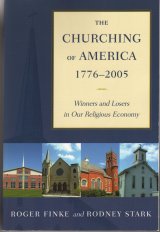
Book Review: The Churching of America (1776-2005)

May 13, 2007


Winners and Losers in Our Religious Economy
by Roger Fink and Rodney Stark

Where do our modern churches come from? How did we get here? And what can we learn from that, to help us move forward? These are crucial questions for the church today. The Churching of America (1776-2005) is a great place to gain insights into these questions.

From the very opening page, this book challenges conventional wisdom:

The most striking trend in the history of religion in America is its growth–or what we call the churching of America. The backbone of this book consists of our attempt to explore and explain how and why America shifted from a nation in which most people took no part in organized religionto a nation in which nearly two-thirds of American adults do. …Not all denominations shared in the immense rise in membership rates, and to the degree that denominations rejected traditional doctrines and ceased to make serious demands on their followers, they ceased to prosper. The churching of America was accomplished by aggressive churches committed to vivid otherworldliness.

The first chapter of the book discusses the methodology of the writers in their investigation into the patterns of church growth in America, and for the causes of those patterns. They viewed the religious environment as a kind of economy, where different denominations compete with their ideas and methods for followers. In the subsequent chapters, they traced not merely the number of adherents in various denominations, but also their market share (percentage of the “churched” population) and market penetration (percentage of the total population). They traced church growth in America, starting in the year 1776, when 17% of the population were members of a church, through the year 2005, when 62% of the population were church members. And in the midst of that dramatic growth, they examined the meteoric rise of particular denominations, and the severe decline of others.

The authors traced the fortunes of the Congregationalists, Episcopals, Presbyterians, Methodists, Baptists, and Catholics starting from colonial days—the decline in market share of the first three, and the gains in the latter three. In particular, the Methodists experienced breathtaking growth, from a 2.5% market share in 1776, to an amazing 34.2% by 1850. That gain in market share is all the more impressive when one considers that the market itself grew in size during those years.

In 1776 the Methodists were a tiny religious society with only 65 churches scattered throughout the colonies. In 1850 there were 13,302 Methodist congregations, enrolling more than 2.6 million members — the largest single denomination, accounting for more than a third of American church members.

The Methodists won America during those years through hard work and a simple, passionate message. The trend started with the revolutionary effect of the great George Whitefield, preaching to tens of thousands at a time and converting thousands. Following Whitefield came a cavalry of circuit riders, men who spent their lives riding on horseback from village to village, holding large evangelistic camp meetings, building and strengthening churches. The message was sin, repentance, and judgment. The congregations were organized into small groups called classes, consisting of a dozen or so people under the care of a class leader. Several of these classes would form a congregation. The preacher of the congregation, more often than not, was a farmer like the the rest of the congregation, receiving little or no pay for his role as minister.

As the Methodists rose, the Congregationalists declined. The decline was not obvious at first because, while they were clearly losing market share, their numbers were growing because the overall population was growing rapidly. But under the liberal influence of their universities (including Harvard and Yale), they were leaving behind many basic convictions about the nature of God and his relationship to man. Humanism and Deism crept in, and the message became ever less compelling. The Methodists, with their passionate plea for repentance and warnings of judgment to come, ate the Congregationalists’ lunch.

After 1850, the Methodists entered their own decline. They had acquired nice buildings and were beginning to employ a university-educated clergy. Their message became diluted and other upstart groups began to take away their market share.

The authors trace a similar pattern through several other religous groups. They identified a common thread distinguishing the winners and the losers. They described a continuum extending from “sects” to “churches”. They used the term “sect” to identify religious groups that exist in strong tension with the culture around them. Sects expect a lot from their members. There is a high cost and a high reward for membership. On the other end of the continuum, the authors applied the term “church” to those religious groups that blend into their culture. For these groups, the cost of membership was not high, and the reward was correspondingly low. The consistent pattern seen in this book is that the sects beat the churches every time. As churches go into decline, sects enter the vacuum and thrive. Thus the overall religious adherence in America has risen steadily for over 200 years, despite the severe decline of many prominent religious groups.

This is a fascinating book for anyone interested in learning lessons from church history. As the saying goes, those who fail to learn from history are destined to repeat it.

h1

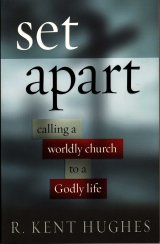
Book Review: Set Apart — calling a worldly church to a Godly life

May 6, 2007

Who can deny … that the evangelical enterprise has become worldly, that materialism grips the church, that pleasure-seeking dominates us, that evangelicals watch sensuality and violence like everyone else, that immodesty is de jure, that voyeurism and pornography and sexual laxity and divorce are on the rise, and that we, like Lot, could find that Sodom has been born anew in our own homes. God help us if while decrying sin, we are sprinting headlong after it.

We must lay this to heart: A worldly church cannot and will not reach the world. — R. Kent Hughes, Set Apart

In Set Apart (available at amazon.com), R Kent Hughes calls our attention to a serious problem in the modern church. He cites multiple sources and calls upon the reader’s own experience to prove that the church has become contaminated by the world. Speaking from the perspective of an evangelical preacher, he urges the church to be “Set Apart to Save.”

In demonstrating the contamination of the church by the world, he calls on us to become set apart from the world in nine areas: materialism, hedonism, viewing sensuality, violence and voyeurism, sexual conduct, modesty, pluralism, marriage, and commitment to the church. On materialism, he shows that the spending habits and debt problems of Christians are no different from those of non-Christians. He shows that Christians pursue the same twisted, dysfunctional pleasures that the world pursues. We watch the same sensual television shows. We entertain ourselves with the same violence. We are immersed in the same warped attitudes toward sex and marriage. Rather than taking a stand against the corrupt values of society, we have blended in. Society tells us that anyone who preaches one true way, to the exclusion of others, is a narrow-minded bigot and a social pariah. So we have kept quiet. Some of us have even begun to believe what society is saying.

Hughes points us to another road. By saying “No” to the world we can say “Yes” to the blessed life to which God calls us. Instead of distorted and dysfunctional pleasures that do not satisfy, we can fully enjoy and participate in the pleasures prepared for us by God. In doing so, we can be a light to the world.

The Restoration Movement churches need to listen to this message. We are immersed in the same culture that Hughes describes, and are taking on the characteristics of that society. If we are to be a light to the world, we must be different. We must be set apart. A worldly church needs to be called to a Godly life–first for our own salvation, but also for the salvation of the world.

h1

Meanwhile…

May 1, 2007

Not only have I finished the blog series on Romans but also I taught the final class in our series on that book at church yesterday. I really enjoy teaching and especially when the topic is something that requires me to really dig. Romans is that kind of book. I probably averaged three hours preparation for each thirty minute class in the series, reading several commentaries and a few books along the way. As a result of all that preparation, I always learn far more than I’m able to communicate in the short class. But with all the other responsibilities of my life, teaching a class like this is a stretch. That’s good for me, but now I’m ready for a break.

My congregation has designated May as Marriage and Family month. This Saturday we will kick it off with a marriage and family workshop. Then beginning Sunday we will be teaching a series of Sunday classes on the subject. We will be following up on this material in our newly reorganized family groups. The goal is to help those who have needs to establish an ongoing support structure that will help them to grow in these areas, not just in May, but continuing into the future. One of our deacons who has been working in these areas (teen ministry, Dynamic Marriage facilitator, group leader for teen parenting, etc) will be teaching these classes.

June’s focus will be household finances. In like manner, we will kick off with a Saturday workshop. Sunday classes in June will focus on followup to the workshop. Family groups will personalize the message, attempting to match up needs with resources (possibly Dave Ramsey materials or something similar). Our two financial / benevolence deacons will be leading the followup.

So my next Sunday teaching assignment will probably not come before July. That gives me time to decide on a topic and get a head start on preparation.

Meanwhile the church has purchased a copy of the book Set Apart by R. Kent Hughes, for each household in the congregation. This is an excellent book hilighting the imperative that the church not be conformed to the world. We will be going over the book in one or more settings (probably including family group discussions) in the coming months. I hope to do a book review on this in the near future.

I have read another book recently which I want to review as soon as the rest of my family members finish with it. The title is The Churching of America (1776-2005): Winners and Losers in Our Religious Economy. That is another great book hilighting the need for the church to be in “tension” with the surrounding culture, and the consequences when it is not. I taught a class from this book a few weeks ago at midweek service, bringing in some additional material from the Restoration Movement to increase awareness of our roots.

All these things are part of our theme for this year of “getting our house in order.” It is our goal that every member will be able to look back at the end of the year and see visible progress on areas where they needed help on January 1… whether the need is marriage, family, finances, personal holiness, Bible study, prayer, relationships with other Christians, evangelism, etc. That’s a pretty broad theme, more of a panorama than a focus. But we are trying to provide concrete help in each area so people can take advantage of what they need most. The goal is to have lives that are pleasing to our Father, bring glory to God, and “make the teaching about God our Savior attractive.”

h1

Romans part 15: Wrapup

April 27, 2007

In the Roman letter, Paul addressed the rift that had emerged between Jews and Gentiles. He based his plea on the fact that both were saved from their sins through the same gospel. As a result of that gospel, they should give up their own rights and serve the greater good of the whole church. They should accept one another despite their differences.

From the last half of chapter 15 through chapter 16, it seems Paul was having a hard time concluding this letter. He knew the Roman church was going to be tested, and he wanted to be sure he had taught everything that could be helpful. So Paul called upon the Christians to teach and admonish one another to be true to the faith:

Rom 15:14 I myself am satisfied about you, my brothers, that you yourselves are full of goodness, filled with all knowledge and able to instruct one another.

He was confident in their goodness and knowledge. Therefore he was confident they were able to instruct one another. Without the goodness, or without the knowledge, he would not have been so confident. Paul had provided them a thorough explanation of the grace they had received. Now it was up to them to teach one another.

Then Paul explained his future plans and his desire to come to Rome. Paul had never visited Rome before, though he obviously knew quite a few people in the church there. He intended to visit them after delivering the gifts from Macedonia and Achaia to the needy Jewish Christians in Jerusalem. Given that Paul had never been to Rome, it is striking how many Christians he knew there. He mentioned by name more than 25 people in chapter 16. For many of these people Paul offered a personal comment, something they had done or some virtue for which they were known. Not only did he know these people, but he knew something about the makeup of the various house churches. Paul was personally connected to this church despite never having visited. He cared about them.

After all the instruction about accepting one another, Paul felt the need to address another threat to their unity. He knew that there were some in Rome who would do harm to the church through false teaching. So he wrote:

Rom 16:17 I appeal to you, brothers, to watch out for those who cause divisions and create obstacles contrary to the doctrine that you have been taught; avoid them.
Rom 16:18 For such persons do not serve our Lord Christ, but their own appetites, and by smooth talk and flattery they deceive the hearts of the naive.

Paul’s instruction was to avoid people who cause division and create obstacles contrary to sound teaching. He called them to be alert to the danger and to avoid contributing in any way to the damage that such people might do.

Finally, Paul concluded by placing the church in God’s able hands. God would give them the strength they would need:

Rom 16:25 Now to him who is able to strengthen you according to my gospel and the preaching of Jesus Christ, according to the revelation of the mystery that was kept secret for long ages
Rom 16:26 but has now been disclosed and through the prophetic writings has been made known to all nations, according to the command of the eternal God, to bring about the obedience of faith
Rom 16:27 to the only wise God be glory forevermore through Jesus Christ! Amen.

Paul concluded where he began in Rom 1:5, speaking of the obedience of faith which was the goal of the gospel. This gospel was the mystery which was secret for long ages, but now disclosed by God’s command. That is the call to the church today. Because we have been considered righteous through faith, we should respond with obedient faith. We should put sin to death. We should accept one another with sincere love. And we should use our gifts to build one another up in the Lord. May God continue to help us as we serve Him in this way!