h1

Through the British Museum with the Bible

December 19, 2009


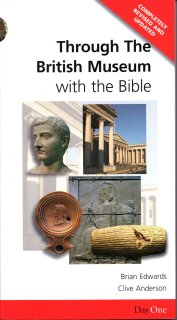
On our return from Sweden, we spent a couple of days in the UK. We devoted one inspiring but exhausting day to the British Museum. Our hosts in the UK provided us with a guide titled “Through the British Museum with the Bible”. With this guide in hand, we entered the museum and were taken back thousands of years.

There was so much to see! We saw relics from Ur of the Chaldeans (Gen 11:28-31, approximately 2600 BC, four or five hundred years before Abraham). We saw a clay tablet in cuneiform telling a pagan corruption of the flood account, with remarkable similarities to the biblical account (including a man instructed by a god to build a boat, to load his family and all types of animals on it; and sending out birds to see if land has emerged.)

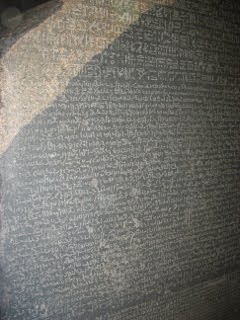
We even saw the Rosetta Stone — one of the most important archaeological finds of all time, enabling scholars to break the code of Egyptian hieroglyphics.
We saw a statue of Tuthmosis III, possibly the Pharaoh during part of Israel’s slavery in Egypt, and another even more impressive one of Rameses II, who possibly was the Pharaoh at the time of the Exodus. (From the look of his statute, he certainly was overly impressed with himself!)

There were documents referring to Nebuchadnezzar and Belshazzar. There were artifacts from Greece, Rome, and Ephesus — more than can be recounted in a blog post.

But what affected me the most was the vast array of carvings from the Assyrian empire, recounting the conquests and the barbaric treatment of those they conquered.
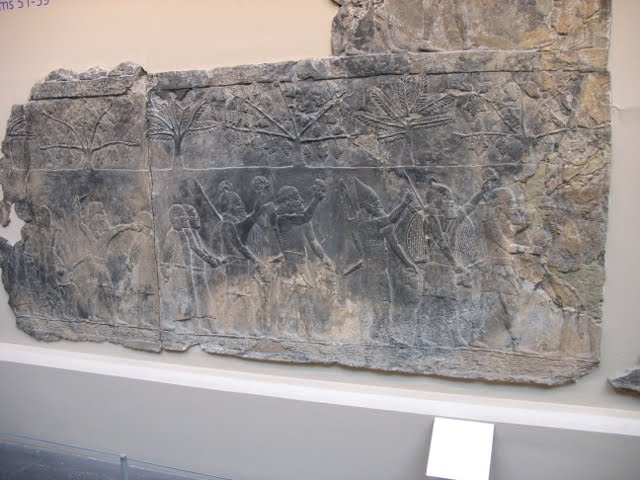
These carvings, which once adorned the walls of the Sennacherib, king of Assyria, tell their history as the king wanted it to be told. Shown above is an Assyrian soldier beheading a conquered enemy soldier (far left), while other soldiers march on waving the heads of other victims. Other carvings shown in the book (which we did not find) show the Assyrians cutting off the hands and feet of the conquered soldiers and impailing their victims on a wall. Another wall-sized series of carvings showed in great detail the Assyrian siege and conquest of Lachish (2 Chron 32; Isa 36) and the brutal treatment of the conquered (including, apparently, skinning some of them alive. Since I have no picture I will refer you to this link).

No wonder Hezekiah tore his robes, put on sackcloth, and poured out his pleas to the Lord in the temple! No wonder the people were terrified! And no wonder Jonah did not want to go to Ninevah! What a dreadful fate, to be conquered by the Assyrians! And that is what happened to Israel.

Also in the museum is the Taylor Prism, containing Sennacherib’s own account of his seige of Jerusalem. Although he had always conquered and destroyed all the other cities he attacked, in the case of Jerusalem he curiously states only that he shut up Hezekiah in the city “like a caged bird,” with no explanation for why he did not conquer that city also. (2 Kings 19:35-36)

I wish I had found the book a few weeks before our visit. There is so much in the museum that I would love to have seen, and perhaps I could have seen more if I had been better prepared. But what I did see was faith-building and inspiring. There is just something about seeing these actual physical pieces of evidence corroborating the biblical account, that gives a sense of strength and confidence. If you have the opportunity, I highly recommend that you visit the British Museum and see the evidence God has preserved for us. It was an experience I will not forget.

h1

Sweden

December 9, 2009

This past weekend my wife and I returned from a business trip to Stockholm, Sweden. While there we had a wonderful opportunity to sit down and talk with the leaders of a local church of Christ (yes, there is at least one!) The couple (Americans) had been part of a mission team that started the church over 20 years ago, and had returned to lead the congregation again in recent years. They were eager for conversation with American Christians, and were more than gracious to drive over to our hotel for a short visit.

It was fascinating to listen to them, to hear their experiences and struggles. I was struck by how different things are for them in Stockholm compared to our situation in the Bible Belt of America.

1) By far most of the people in Stockholm are atheists. The approach for reaching out to them is therefore much different our approach in the American South. Their discussions focus on things like philosophy, ethics, the origin of the universe, the origin of life, etc. I would love to spend hours listening to them talk about the different approaches they have used in attempts to persuade people to consider Christ, and to bring them to maturity from such a remote starting point.

2) Their culture is very feminist — characterized by strong women and passive men. That creates lots of issues even in the church.

3) In Sweden it is illegal to spank your children (and it has been so for 30 years). Children can report their own parents as abusers by dialing a simple three digit phone number… and that can lead to the child being taken from the parents. As a result, parents are fearful of disciplining their children. Naturally, children grow up without proper respect for authority. This is a real challenge for the church, as they try to carry out their mission to the next generation.

I am reminded of a few things:
1) The need to pray for our brothers and sisters in places like Stockholm.
2) How blessed we are in America, though we admittedly have our own challenges!
3) The need for mature Christian leaders to travel to these young congregations to give advice and to share experiences. This couple genuinely appreciated our short visit. Longer would have been better. Not that I feel like my input is all that special — but they were eager for every thought I offered.

This couple were eager for our input on questions related to raising children — including how to know when a child is ready for baptism. There is such a shortage of people with that kind of experience. Here is yet one more reason for mature American Christians to visit mission congregations. Perhaps that would be a great way to spend retirement.

Meanwhile, please pray for our brothers and sisters in places like Stockholm.

h1

Where’s This Blogger?

November 23, 2009

Crickets are chirping….

I’ve been swamped with some major projects in the past few weeks. That’s likely to continue to be the situation through the end of the year, but I hope to have a thing or two to say here along the way.

I’m in the process of putting together a pilot online course to evaluate a platform for delivering “extra-curricular” courses to our congregation. I’ll be using moodle and dimdim as the course delivery platform. If everything works out, I may be able to enable students to take the course inside Facebook using a Moodle plugin called Podclass. The class begins in early January.

Meanwhile I’m also trying to help with another online course experiment using Second Life.

I’m also busy with a project at work which is consuming a lot of my bandwidth. That should taper off by mid-December. Hopefully I’ll be able to resume a weekly blogging schedule soon.

h1

Bible Software Review: e-Sword

November 2, 2009

One of my favorite resources for Bible study is a free software package called e-Sword, by Rick Meyers. From the e-Sword web site:

“Freely you received, freely give.” (Matthew 10:8) Jesus told us that since we’ve been blessed we should bless others. I am happy to provide a blessing to others in the form of free Bible study software!

e-Sword provides a wealth of Bible translations, commentaries, dictionaries, and related resources, most of which are free. Additionally, a good selection of copyrighted resources are available for purchase from the respective copyright holders.

This review addresses version 7.7.7, which is the version I have installed under Linux using wine on this ubuntu 8.10 machine. Newer versions have replaced this version, but the comments below generally apply to the current version as well.

The installed resources are presented in the e-Sword software in a well-designed layout that makes the tool a joy to use.


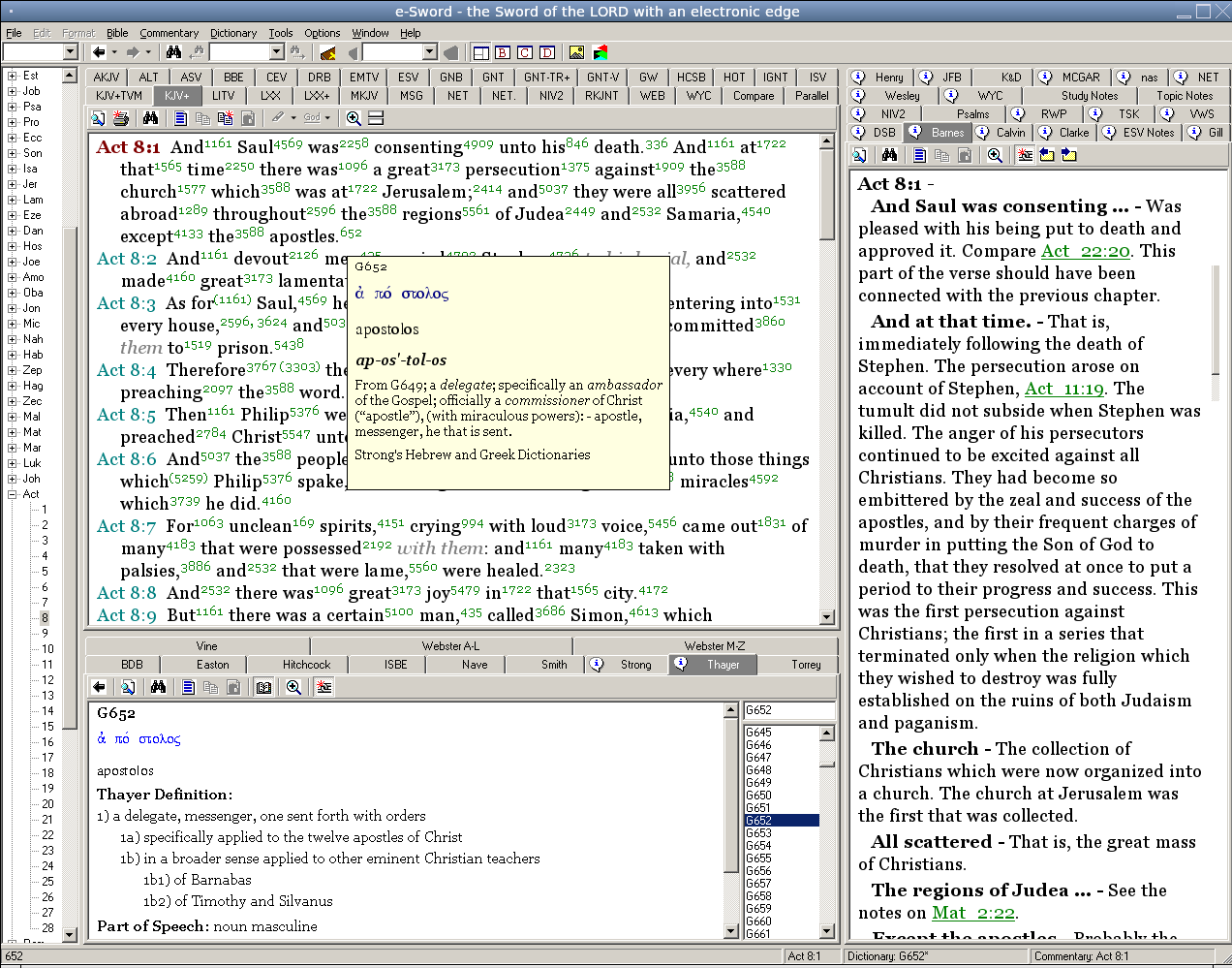
The main window includes three main areas, containing the Bible text, the selected commentary, and the selected dictionary. Each of the three sections can be expanded to fill the window.

A tool for navigating the Bible appears on the left side of the screen. When you select a book, chapter, and verse, the Bible and (optionally) commentary windows are advanced to the selected passage. When a particular commentary has comments on the selected verse, an “I” information icon appears in its tab, making it extra convenient to review what various commentators had to say about the passage.

One of the available commentaries is the Treasury of Scriptural Knowledge (TSK). This commentary is really an extensive cross reference directory, showing other passages addressing similar concepts, enabling the scriptures to become a commentary on themselves — the best of all commentaries.

Throughout e-Sword, Bible references act as hyper-links so clicking on the link takes you to that passage in the Bible window. Alternatively, you can see the referenced passage in a popup bubble by hovering the mouse over the link.

The King James Version is provided with Strong’s concordance links. Hovering over these links results in a popup bubble with the Strong’s definition for that word in Hebrew or Greek. Clicking on the link takes you to that word in the Strong’s and/or Thayer dictionary.


Among the many resources available are topic files (.top) which cover a plethora of topics, including the nine-volume Anti-Nicene Fathers, the Wars of the Jews by Josephus, Fox’s Book of Martyrs, and many other documents from the early church period, as well as many from the early Reformation Movement and the modern period.

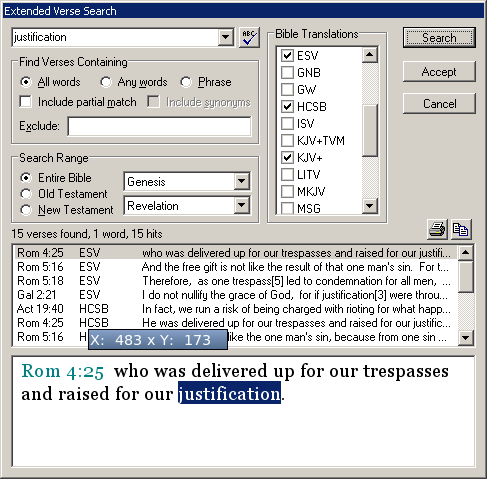
Bible searches can be conducted across a single version, or across multiple selected versions.
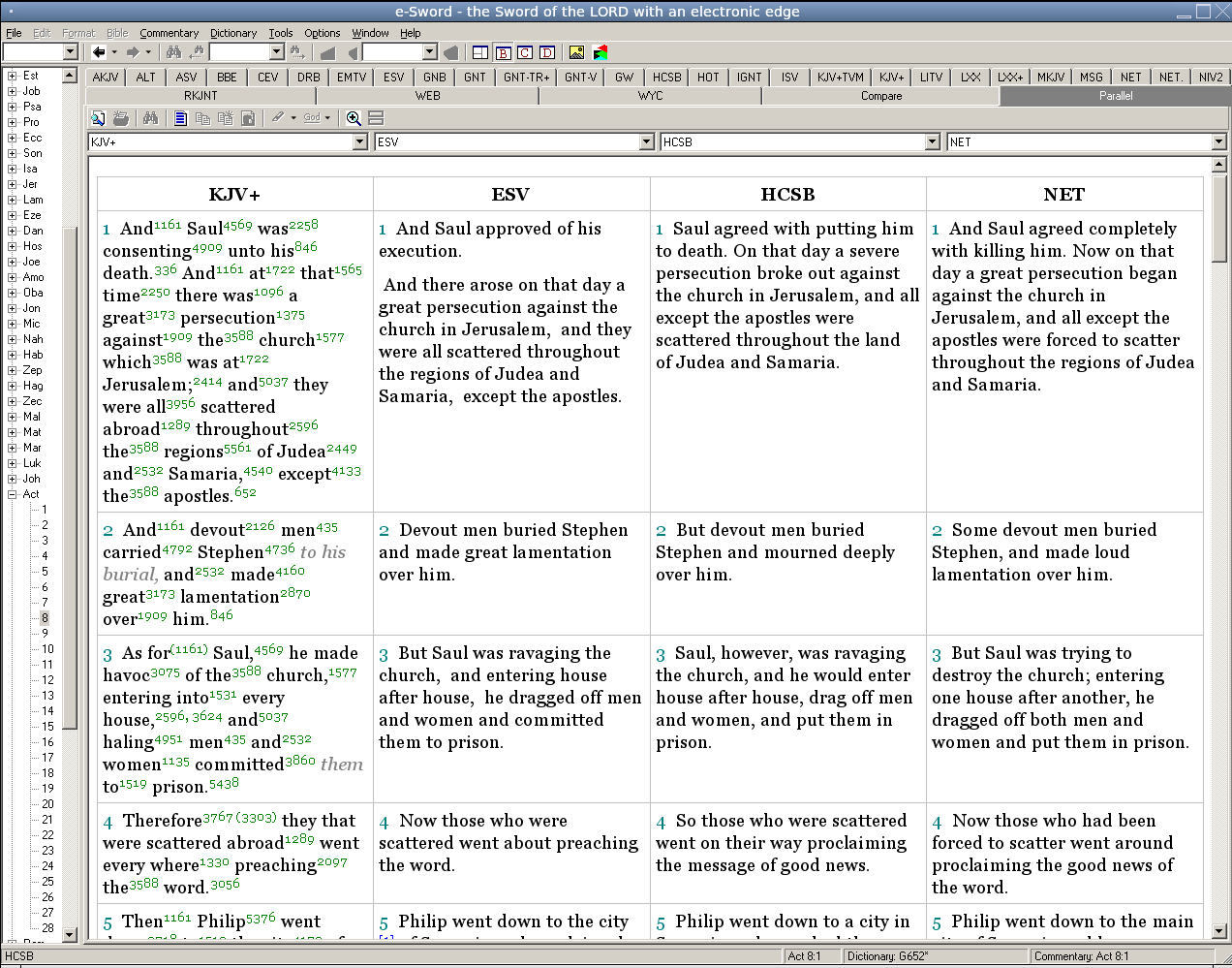
A parallel view is supplied enabling you to view up to four versions of your choice side-by-side.

Or, you can compare a selected verse across all the installed translations:

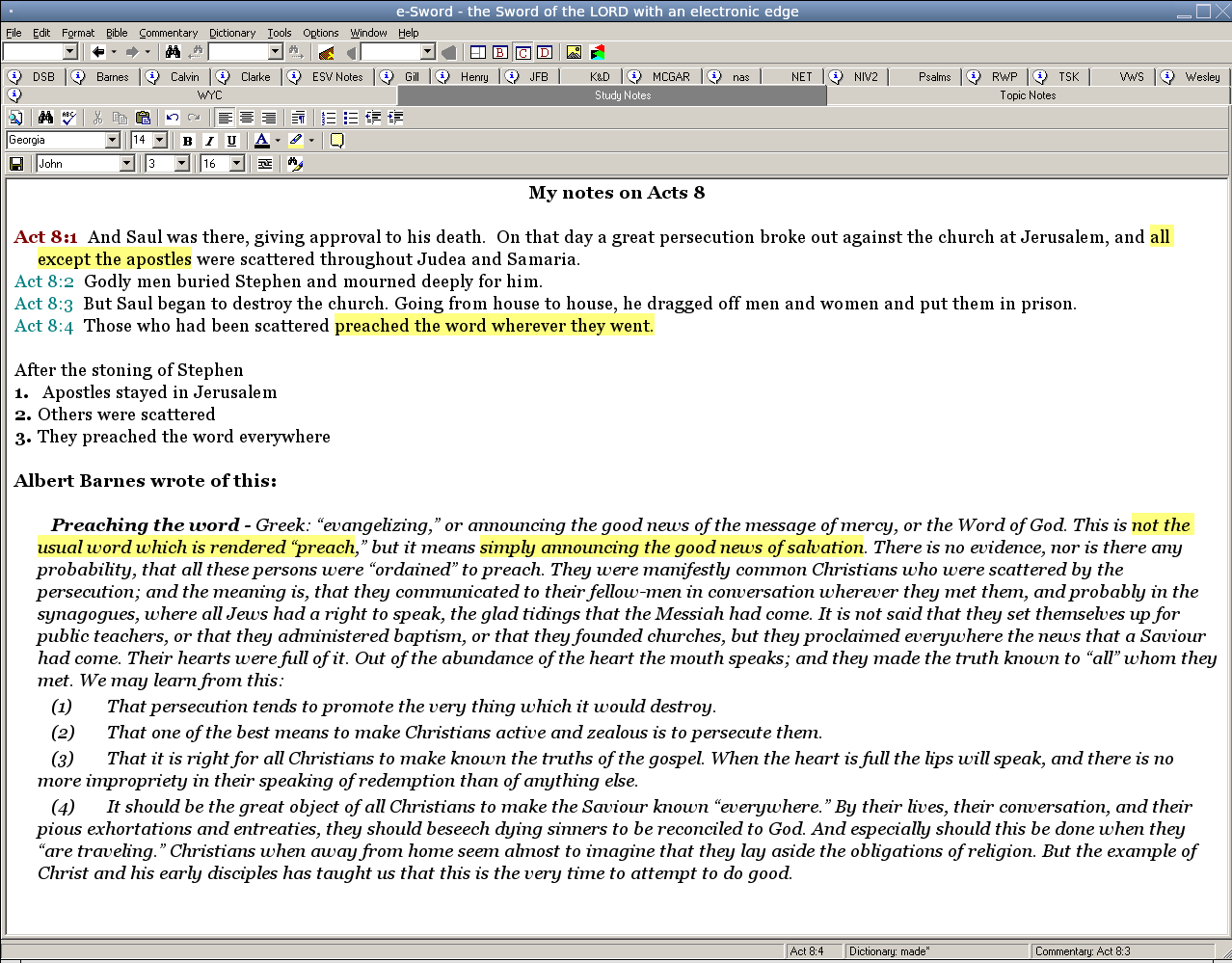
There is also a built-in editor with most of the essential features of a word processor, which is a convenient way to create your own study notes.


Other features include a Step reader, a graphics viewer, a scripture reading tool, a scripture memory tool, and a prayer request tool.

One limitation of the e-Sword scripture reading tool is that it does not offer an option to use paragraph-style presentation of the scripture. The text is always shown with each verse starting on a new line. This is how I prefer it anyway for Bible study, but some people prefer the paragraph style for reading.

There are other free Bible software packages for Windows and/or Linux. The Sword Project is an open source Bible study framework on which multiple Bible study applications have been built. The Sword Project applications can be built for a variety of operating systems. The Sword Project and its companion interfaces provide many similar features, but lack some of the paid copyrighted resources. In particular, the NIV is not permitted to be used in any open source software package.

Another option is The Word, a closed-source Windows Bible application. I hope to try The Word in the future and perhaps will offer a review of it at that time. Currently The Word has some of the same limitations as The Sword Project regarding modern copyrighted Bible translations. But perhaps that will change in the future.

I have used e-Sword for many years and am quite satisfied with it for my Bible study purposes. However, there are enthusiastic users of all of these applications. Those who invest their time and skills to provide these tools free of charge are to be commended and appreciated. If you should decide to use one of these, I urge you to make a donation to support the tool of your choice.

h1

Online Teaching Platforms

October 26, 2009


Matt 24:45-51 “Who then is the faithful and wise servant, whom the master has put in charge of the servants in his household to give them their food at the proper time? It will be good for that servant whose master finds him doing so when he returns. I tell you the truth, he will put him in charge of all his possessions. But suppose that servant is wicked and says to himself, ‘My master is staying away a long time,’ and he then begins to beat his fellow servants and to eat and drink with drunkards. The master of that servant will come on a day when he does not expect him and at an hour he is not aware of. He will cut him to pieces and assign him a place with the hypocrites, where there will be weeping and gnashing of teeth.


2 Tim 3:16-17 All Scripture is God-breathed and is useful for teaching, rebuking, correcting and training in righteousness, so that the man of God may be thoroughly equipped for every good work.


Acts 20:26-27 Therefore, I declare to you today that I am innocent of the blood of all men. For I have not hesitated to proclaim to you the whole will of God.

A primary responsibility of congregational leaders is to teach them the Bible. To me that means that we must teach the “whole” Bible, not just selected excerpts. If not, then who is responsible for teaching it?

Our congregation’s schedule provides for three teaching opportunities each week, plus occasional events outside the regular schedule. We are further limited by the fact that we do not own a building, so scheduling additional opportunities requires us to find (rent) a place. When we do teach, we have one or two large classes to meet the needs of the entire congregation. That just seems inadequate to me. If we continue in this manner, how will we ever get the entire church taught the entire Bible? We need a new approach.

The internet provides a possible answer.

Adoption of online training has exploded in the past decade. Tens of thousands of courses have been offered using an open source course management product called Moodle. In turn, Moodle has been interfaced to various social networking environments where classes can be conducted in a social setting. Facebook users can take classes using the PodClass interface. For a more futuristic environment, SecondLife users can take classes through the Sloodle interface.

I’m dipping my toe into the pool. Just a little. I would love to find a way to provide additional Bible study opportunities in the local congregation — ways that don’t require people to be physically present at the same time, and that don’t require renting a facility. The technology seems to be available. I want to learn how to apply that technology effectively, combining both online and “real life” interactions and sound adult educational principles. I want to evaluate whether it is a feasible way to enhance our existing Bible teaching methods.

I would like to hear from folks who have experience in these or other similar courseware environments. What worked, and what didn’t? What could have been done better?

h1

1 Peter: Godly Suffering, Part 2

October 18, 2009

Martyrdom.

That sobering subject may have been part of what the Holy Spirit had in mind when Peter wrote to the scattered saints about godly suffering. The book was most likely written between AD 60-64, during the reign of Nero. Peter may well have been writing to prepare the disciples for the persecution that would occur in AD 64 under Nero. In that year, a great fire broke out in Rome, and a substantial portion of the city was burned. Some of the Roman people began to attribute blame to Nero himself. Nero responded by deflecting the blame to the Christians. The Roman historian Tacitus wrote:

…they were covered with the hides of wild beasts, and worried to death by dogs, or nailed to crosses, or set fire to, and when the day waned, burned to serve for the evening lights.

That such cruelty was done to saints of God seems unimaginable to our modern western minds. Nero’s cruelty was shocking even to many Roman witnesses in that day. But that is what happened within a short time after Peter’s first letter was written. It is hardly surprising that Peter would write to prepare the believers for what was about to come.

With that bit of historical background, let’s consider what Peter said on the topic of suffering in his first letter.

1Pe 1:6-7 In this you greatly rejoice, though now for a little while you may have had to suffer grief in all kinds of trials. These have come so that your faith–of greater worth than gold, which perishes even though refined by fire–may be proved genuine and may result in praise, glory and honor when Jesus Christ is revealed.

Peter introduced the subject of Christian suffering early in the first chapter. He compared the suffering of Christians to the refining of gold by fire — certainly suggestive of a fiery test of their faith. (He came back to the fiery imagery in 1 Pet 4:12) Peter indicated that there would be “all kinds of trials” which would prove the genuineness of their faith. There would be a reward of praise, glory, and honor for those who passed the test — a reward to be received when Jesus returns.

1Pe 2:18-20 Slaves, submit yourselves to your masters with all respect, not only to those who are good and considerate, but also to those who are harsh. For it is commendable if a man bears up under the pain of unjust suffering because he is conscious of God. But how is it to your credit if you receive a beating for doing wrong and endure it? But if you suffer for doing good and you endure it, this is commendable before God.

Of course not all would personally face martyrdom at the hands of Nero. Some would face suffering of a different kind. Maybe this comes closer to the kind of suffering that modern Christians in western countries might face – unjust treatment because of faith in Jesus. But in reality, very few of us actually face beatings for our faith, as some first century slaves apparently did. Peter instructed them to “bear up under the pain” because they are conscious of God — in other words, to stand resolutely on their faith even when it cost them a beating, in order to receive the commendation of God.

1Pe 2:21 To this you were called, because Christ suffered for you, leaving you an example, that you should follow in his steps.

Christ suffered even to the point of death in order to fulfill God’s purpose. Therefore, Peter taught, Christians should likewise refuse to back down in the face of persecution.

1Pe 3:13-14 Who is going to harm you if you are eager to do good? But even if you should suffer for what is right, you are blessed. “Do not fear what they fear; do not be frightened.”

Persecution forces Christians to choose whom they will fear. In the above passage, Peter referred to the words of God recorded by Isaiah the prophet:

Isa 8:12 “Do not call conspiracy
everything that these people call conspiracy;
do not fear what they fear,
and do not dread it.
Isa 8:13 The LORD Almighty is the one you are to regard as holy,
he is the one you are to fear,
he is the one you are to dread,
Isa 8:14 and he will be a sanctuary;

It seems that Peter, like Isaiah, had in mind a kind of persecution that could cost a person his life. Consider the following familiar passage in the context of that kind of suffering:

1Pe 3:15 But in your hearts set apart Christ as Lord. Always be prepared to give an answer to everyone who asks you to give the reason for the hope that you have. But do this with gentleness and respect,
1Pe 3:16 keeping a clear conscience, so that those who speak maliciously against your good behavior in Christ may be ashamed of their slander.
1Pe 3:17 It is better, if it is God’s will, to suffer for doing good than for doing evil.

They were to set apart Christ as Lord. That title was to be reserved for Christ alone, and not to be applied to the emperor. Each Christian was to be resolved in his or her own mind how to answer if faced with the awful choice of martyrdom or denial of Christ. They were to be prepared in advance to answer with gentleness and respect, and to embrace the suffering rather than to commit the great evil of denying Jesus.

1Pe 4:12-13 Beloved, do not be surprised at the fiery trial when it comes upon you to test you, as though something strange were happening to you. But rejoice insofar as you share Christ’s sufferings, that you may also rejoice and be glad when his glory is revealed. [ESV]

Clearly there was a “fiery trial” that was about to confront them. Peter was concerned that the believers might be frightened into denying the faith during the coming trial.

1Pe 4:15-16 If you suffer, it should not be as a murderer or thief or any other kind of criminal, or even as a meddler. However, if you suffer as a Christian, do not be ashamed, but praise God that you bear that name.

He anticipated that they would face punishment for their belief in Jesus. He warned them about being ashamed and admonished them not to shrink back from testifying that they bear the name of Christ. For some of them, such testimony would cost them their lives. Peter remembered the words of Jesus:

Mar 8:38 For whoever is ashamed of me and of my words in this adulterous and sinful generation, of him will the Son of Man also be ashamed when he comes in the glory of his Father with the holy angels.”

He also undoubtedly remembered his own denials of Christ during the Savior’s last few hours on earth. He must have remembered the Lord’s words at that post-resurrection breakfast on the shore, recorded in John 21, asking Peter if he truly loved the Lord. He remembered the kind of death that Jesus had predicted for him. He had spent the subsequent 30 or so years getting ready to face his own personal test. And he charged all his readers with being ready for similar testing.

1Pe 4:17-18 For it is time for judgment to begin with the family of God; and if it begins with us, what will the outcome be for those who do not obey the gospel of God?
And,
“If it is hard for the righteous to be saved,
what will become of the ungodly and the sinner?”

The coming persecution was a judgment on the family of God. It would separate those with genuine faith from those who lacked it. It would be hard for the righteous to be saved. This was no lightweight test. The only way to pass was to be willing to die for the faith.

How would we fare under such a test? Would our faith survive the fiery trial? Do we survive the much lighter trials we actually do face? Sobering questions.

h1

1 Peter: Godly Suffering, Part 1

October 13, 2009

Before we look at what Peter wrote about suffering, let’s take a quick look at the attitudes of the Israelites toward godly suffering through the previous ages.

Suffering was not a new subject when Peter wrote. Some of the earliest writings in the Old Testament tell us of the suffering of godly men. Two (of many) prominent examples are Joseph and Job.

Joseph suffered as a slave and as a prisoner for a crime he did not commit, for a period of 13 years. (Gen 37-41). Joseph suffered righteously, and God used his suffering to bring about great things for the sons of Israel.

Job suffered as Satan tested his faith in God. Job lost his family, his wealth, and his health. He suffered righteously, and by doing so he brought glory to God. But he suffered a lot.

Despite prominent examples of godly suffering such as these, the Israelites had a hard time accepting the idea that the righteous should suffer. The psalmist (probably David) wrote:

Psa 44:17 All this happened to us,
though we had not forgotten you
or been false to your covenant.
Psa 44:18 Our hearts had not turned back;
our feet had not strayed from your path.
Psa 44:19 But you crushed us and made us a haunt for jackals
and covered us over with deep darkness.

And in another psalm, Asaph wrote:

Psa 73:12 This is what the wicked are like— always carefree, they increase in wealth.
Psa 73:13 Surely in vain have I kept my heart pure; in vain have I washed my hands in innocence.

To man, it seems that only the wicked should suffer, and that the righteous should be rewarded in this life. To endure suffering in this life, in order to gain rewards in the next, requires great faith. Sometimes we feel it requires more faith than we have.

Early in his ministry, near the beginning of the Sermon on the Mount, Jesus said:

Mat 5:11 “Blessed are you when people insult you, persecute you and falsely say all kinds of evil against you because of me.
Mat 5:12 Rejoice and be glad, because great is your reward in heaven, for in the same way they persecuted the prophets who were before you.

Jesus expected us to rejoice when we suffer for him, because of our reward in heaven.

When Jesus sent out the twelve (Matt 10), he told them he was sending them out as sheep among wolves. He told them they would be arrested, called before councils and flogged. He told them they would be hated and they would be betrayed. But he sent them anyway. And he told them that those who stand firm to the end would be saved.

In Matthew 16, we get a glimpse into Peter’s attitude toward suffering:

Mat 16:21 From that time on Jesus began to explain to his disciples that he must go to Jerusalem and suffer many things at the hands of the elders, chief priests and teachers of the law, and that he must be killed and on the third day be raised to life.
Mat 16:22 Peter took him aside and began to rebuke him. “Never, Lord!” he said. “This shall never happen to you!”

Peter did not think it was a good plan for Jesus to suffer. Jesus rebuked him sharply for that.

Later, Peter would try to fight to prevent the arrest of Jesus. After the arrest, he would deny Jesus three times rather than risk suffering alongside Jesus. After the resurrection, Jesus confronted Peter’s unwillingness to suffer:

Joh 21:18 Jesus said, “Feed my sheep. I tell you the truth, when you were younger you dressed yourself and went where you wanted; but when you are old you will stretch out your hands, and someone else will dress you and lead you where you do not want to go.”
Joh 21:19 Jesus said this to indicate the kind of death by which Peter would glorify God. Then he said to him, “Follow me!”

Peter was going to have to suffer for Jesus. Having seen Jesus crucified only a few weeks earlier, these words must have cut to his very soul. He would live with these words for over thirty years before they would be fulfilled. Peter, not wanting to face that future suffering, responded:

Joh 21:21 When Peter saw him, he asked, “Lord, what about him?”
Joh 21:22 Jesus answered, “If I want him to remain alive until I return, what is that to you? You must follow me.”

What a hard teaching for Peter to accept! How many of us would have accepted that we had to suffer so profoundly, yet another disciple would not? Yet that is what Jesus called Peter to accept. Peter was going to have to suffer.

During the book of Acts, we see a transformed Peter. In chapter 4 the Jewish rulers were astonished at his courage. Later, after being released, they joined the other disciples and prayed — not for safety, but for boldness. And in chapter 5, the apostles went right back out into the streets to preach.

In chapter 12, Peter is once again in prison. King Herod had put James the brother of John to death. Seeing that this pleased the Jews, he then arrested Peter. When the angel of the Lord comes to set Peter free, he finds Peter… sleeping like a baby!

What a remarkable transformation had occurred, compared to the Peter we saw in the latter chapters of the gospels! By the time Peter was writing his first letter to the Christians, he had spent thirty years proving his repentance for shrinking back from suffering.

Next time: Peter teaches us about suffering.

h1

1 Peter: Godly Relationships

October 6, 2009

One of the themes of the book of 1 Peter is that Christians should have godly relationships. The great salvation we have received in Christ demands that we treat other people differently.

1Peter 1:22 Now that you have purified yourselves by obeying the truth so that you have sincere love for your brothers, love one another deeply, from the heart.

A prerequisite for us to love one another in that way is that we first have purified ourselves by obeying the truth. Having done that, we will be capable of loving deeply, from the heart. Without purifying ourselves, the sin in our lives would block the kind of deep love God wants us to have.

1Peter 2:1 Therefore, rid yourselves of all malice and all deceit, hypocrisy, envy, and slander of every kind.

The particular sins that Peter lists are all of an interpersonal nature. They are the kind of sins that ruin relationships. Let’s take a look at them one at a time.

First, we are called to rid ourselves of all malice. Malice is that evil intent that desires to harm someone else — the very opposite of love. Christians must not wish for evil to come upon a brother or sister. There can be no seeking revenge in our relationships. Instead we must be quick to forgive, and to forget. God removes our sins as far as the east is from the west (Psa 103:12). We should forgive in the same way.

We should also rid ourselves of all deceit. It is impossible to have a relationship of love when you don’t let the other person know the real “you.” The motive behind deceit may be greed (tricking someone out of their money or possessions), pride (denying our own failures), malice (scheming to bring harm on someone), or many other similar evil motives. Regardless of the motive, deceit prevents real love.

Peter also wrote that we should rid ourselves of hypocrisy. Hypocrisy is holding others to a standard that we ourselves do not meet. It is pure selfishness, being concerned about our own comfort and pride but having no compassion for the other person. Hypocrites place heavy burdens on others but do not bear those burdens themselves. Jesus reserved his most stern rebukes for the hypocritical Pharisees (Matt 23).

The next evil Peter listed is envy. Envy is a form of hatred of others, because they possess something that we want but do not possess. It is the form of evil that causes the poor to hate the rich. It causes us to hate those who are more successful than us in any area of life. Quite obviously we cannot love those whom we envy. Instead, we should rejoice with those who rejoice (Rom 12:15).

The final evil in Peter’s list is slander. The Greek word here is καταλαλιας, which literally means speaking against. Slander involves all kinds of evil speaking against one another, and it destroys love. The proverb we learned from our mothers is appropriate here: If you cannot think of something nice to say, don’t say anything. Paul wrote that we should only speak what builds others up (Eph 4:29). James wrote that we must not speak evil against one another (James 4:11). And if it is wrong to speak evil against our brother, it is wrong to listen to one who is doing it. If we would all refuse to listen to that kind of talk, it would put an end to evil speaking in the church.

Peter next reminds us that we are the people of God, a royal priesthood, a holy nation. That is all about our position in Christ and our relationships which result. We should treat one another as royal priests and as holy ones of God. We should be using our voices to praise God, not to criticize our brothers. As James wrote:

Jam 3:10 Out of the same mouth come praise and cursing. My brothers, this should not be.

Peter then writes about giving proper respect to everyone. That includes respecting authority and obeying the law; loving our brothers; and fearing God. Respect has to come from a humble heart. As the famous poet wrote:

“Every man is in some way my superior.” – Ralph Waldo Emerson

An attitude like that fosters respect. We would all be better off if we would respect others in this way.

After giving instructions to wives (submit to your husbands) and husbands (being considerate, showing respect), Peter summarizes:

1Pe 3:8-9 Finally, all of you, live in harmony with one another; be sympathetic, love as brothers, be compassionate and humble. Do not repay evil with evil or insult with insult, but with blessing, because to this you were called so that you may inherit a blessing.

There is more in 1 Peter about our relationships: Not retaliating (1 Peter 2:21-25); showing hospitality and serving (1 Peter 4:9-10), the relationship of elders to the church (1 Peter 5:1-4), and submission of the young men (1 Peter 5:5-6). What a great improvement there would be in the church if we all would follow these instructions!

h1

ICOC Cooperation Agreement: The Sequel

September 21, 2009

Our congregation has decided to affirm the August 2009 revision of the ICOC Plan for United Cooperation. I am fully in support of this decision. Since I rather famously objected to the original version, it seems appropriate for me to explain why I am comfortable with affirming the new document.

Each of the two documents begins with a statement of purpose. The original document states:

The purpose of the following paper is to affirm and enhance the unity of the family of churches known, since 1992, as the International Churches of Christ.

The revised document states:

The purpose of this document is to provide a structure for Regional and International cooperation among our family of churches around the world.

The difference in the two purpose statements is representative of the difference in the two documents as a whole. My original objection was that the first document defined a subset of the worldwide church based on a set of doctrinal beliefs and practices. I have always believed that there is a doctrinal boundary to the worldwide church, comprised of the basic gospel facts which must be understood in order to become a Christian. But the original document defined a narrower boundary in which a person had to agree with additional interpretations beyond the core gospel facts in order to participate. My objection was not over any particular doctrine on which that document called for agreement. Instead, my objection was over the principle of defining a subset of the worldwide church based on a set of beliefs in addition to the core gospel doctrines. To me, that seemed to create a faction in the church. While many have disagreed with me about that, it still appears that way to me.

The new document abandons that approach. Instead of trying to define a subset of the church based on peripheral doctrines, it simply seeks to establish a basis for cooperation among willing congregations. It calls for “sound doctrine” but it doesn’t attempt to list the doctrines on which there must be agreement. For example, our congregation can disagree with others in the co-op on topics like the role of women, without for that reason being excluded from the co-op. To me, that is a significant because it respects the consciences of churches and church leadership groups in a manner consistent with Romans 14.

Someone might object that the new agreement still references the old in the footnotes, and therefore affirming the second document is equivalent to affirming the first. I asked the same question, and was assured that the new document does not incorporate the old. That makes sense to me. They produced the new document to address the concerns of people like me, so we could cooperate with a clear conscience. It would make no sense to do that if they were going to still require agreement to the first document.

Here is my heart in the matter. I deeply appreciate the effort of those who produced a plan for cooperation which people like me can affirm. I believe they did this in order to address concerns like mine. I want to express my gratitude for that, and to demonstrate that gratitude by affirming the new document.

Despite not affirming the first document, our congregation has continued to cooperate in foreign missions, regional meetings, conferences, bringing in guest speakers, sending out guest speakers, and in many other ways. We strongly believe in the stated purpose of the new document, and can demonstrate that belief by our past actions. We affirm our desire to cooperate with these congregations to do God’s work around the world. May God bless our collective efforts.

h1

1 Peter: Holy Living

September 15, 2009

Several themes run through the book of 1 Peter:

  1. The great salvation we are receiving
  2. Our response to salvation:
  • Holy living
  • Godly relationships
  • Suffering as a Christian

In this article we will take a look at the necessity of responding with a holy life.

God has done amazing things on our behalf. Even in our corrupt, fallen state, we instinctively know that we should respond with gratitude for the great grace and mercy of God. The book of 1 Peter instructs us on the kind of grateful response God desires.

1Pe 1:13-16 Therefore, prepare your minds for action; be self-controlled; set your hope fully on the grace to be given you when Jesus Christ is revealed. As obedient children, do not conform to the evil desires you had when you lived in ignorance. But just as he who called you is holy, so be holy in all you do; for it is written: “Be holy, because I am holy.”

Grace should motivate us to change how we live. We learn God’s ways, and we choose to live by them, to be self-controlled, and to leave our former evil ways behind. God calls us to be holy, because he himself is holy.

What does it mean to be holy?

  • When Moses stood on holy ground, he was commanded to remove his sandals. Holiness demands to be honored. (Ex 3:5)
  • Mount Sinai was holy. (Ex 19:23) Moses had to put a boundary around it to keep the people off the mountain, so that they would not be put to death. (Ex 19:12-13)
  • In the tabernacle was the Holy Place. When performing his service there, Aaron had to wear a certain robe with bells so that he would not be put to death. (Ex 28:34-35)
  • Beyond the Holy Place was the Most Holy Place. Only the High Priest could enter the Most Holy Place, and he could only enter once a year. He could not enter without blood, because blood was essential to make atonement for his sins and for the sins of the people.

When something is holy, it must be kept from all uncleanness. It must be reserved (sanctified) for holy uses. That which is holy must be treated with reverence. There are severe consequences for profaning what is holy.

Now stop and think about this: We are called to be holy.

1Pe 1:17-19 Since you call on a Father who judges each man’s work impartially, live your lives as strangers here in reverent fear. For you know that it was not with perishable things such as silver or gold that you were redeemed from the empty way of life handed down to you from your forefathers, but with the precious blood of Christ, a lamb without blemish or defect.

In order to be holy, we must live as strangers in this unholy world. We just cannot fit in. After all, we were redeemed through the most precious, sacred, and holy of sacrifices. We dare not treat those sacrifices as unholy:

Heb 10:28-31 Anyone who rejected the law of Moses died without mercy on the testimony of two or three witnesses. How much more severely do you think a man deserves to be punished who has trampled the Son of God under foot, who has treated as an unholy thing the blood of the covenant that sanctified him, and who has insulted the Spirit of grace? For we know him who said, “It is mine to avenge; I will repay,” and again, “The Lord will judge his people.” It is a dreadful thing to fall into the hands of the living God.

So it is unthinkable that we would not respond to the incomparable gift we have received, by being holy ourselves.

Therefore, we must get rid of the unholy ways of our flesh:

1Pe 2:1 Therefore, rid yourselves of all malice and all deceit, hypocrisy, envy, and slander of every kind.

We are to rid ourselves of these things. Nobody will do this for us — although the Holy Spirit will certainly help, when we make the effort.

1Pe 3:10-12 For,
“Whoever would love life
and see good days
must keep his tongue from evil
and his lips from deceitful speech.
He must turn from evil and do good;
he must seek peace and pursue it.
For the eyes of the Lord are on the righteous
and his ears are attentive to their prayer,
but the face of the Lord is against those who do evil.”

Yes, Christians are forgiven. Yes, that includes sin that we commit as Christians. But it absolutely does matter how we live.

Heb 12:14 Make every effort to live in peace with all men and to be holy; without holiness no one will see the Lord.

We have heard the term “holy” so often, and have seen actual holiness so seldom, that we really don’t even understand how far we fall short of that standard. I think we tend to cut ourselves way too much slack in this area. Holy living is not just a good idea.